how do you classify organisms into domains and kingdoms
1.3: Compartmentalisation - The Three Realm System
- Pageboy ID
- 2699

Learning Objectives
- Delimit evolution.
- Name the 3 Domains of the 3 Domain system of classification and recognize a description of each.
- Name the four kingdoms of the Domain Eukarya and recognize a verbal description of apiece.
- Delimitate horizontal gene transfer.
The World is 4.6 billion years old and microbial life is thought to feature first appeared between 3.8 and 3.9 billion years ago; as a matter of fact, 80% of Earth's chronicle was exclusively microbial life. Microorganism life is still the dominant life form happening Earth. It has been estimated that the aggregate number of microbial cells on Earth on the order of 2.5 X 1030 cells, making it the major divide of biomass on the major planet.
Phylogeny refers to the evolutionary relationships betwixt organisms. The Ternion Domain Scheme, projected by Woese and others, is an evolutionary model of phylogeny based on differences in the sequences of nucleotides in the cell's ribosomal RNAs (rRNA), as cured as the cell's membrane lipid construction and its sensibility to antibiotics. Comparing rRNA structure is especially useful. Because rRNA molecules throughout nature channel out the same function, their structure changes very little ended time. Therefore similarities and dissimilarities in rRNA nucleotide sequences are a good indication of how related or unrelated several cells and organisms are.
There are various hypotheses as to the origin of organism and organism cells. Because entirely cells are like in nature, it is generally thought that entirely cells came from a grassroots ascendent mobile phone termed the final ecumenical common ancestor (LUCA). These LUCAs eventually evolved into three different cell types, apiece representing a domain. The three domains are the Archaea, the Bacteria, and the Eukarya.

More recently various optical fusion hypotheses have begun to dominate the lit. One proposes that the diploid or 2N nature of the eukaryotic genome occurred after the fusion of two haploid or 1N prokaryotic cells. Others propose that the domains Archaea and Eukarya emerged from a common archaeal-eukaryotic ancestor that itself emerged from a member of the domain Bacterium. Some of the tell behind this hypothesis is based connected a "superphylum" of bacteria called PVC, members of which divvy up some characteristics with some archaea and eukaryotes. On that point is growing evidence that eukaryotes may have originated within a subset of archaea. In any event, it is accepted nowadays that there are three distinct domains of organisms in nature: Bacteria, Archaea, and Eukarya. A description of the three domains follows.
Domains?
Thither is a "superphylum" of bacteria called PVC, referring to the three members of that superphylum: the Planctomycetes, the Verrucomicrobia, and the Chlamydiae. Members of the Polyvinyl chloride, while belonging to the domain Bacteria, show extraordinary features of the domains Archaea and Eukarya.
Some of these bacterium show cell compartmentalisation wherein membranes surround portions of the cellular phone interior, such as groups of ribosomes or DNA, similar to eukaryotic cells. Some separate by budding or bear sterols in their membranes, again similar to eukaryotes. Some want peptidoglycan, similar to eukaryotes and archaea. IT has been surmised that these bacteria migh be an intermediate step between an ancestor that emerged from a bacterium (domain Bacteria) and an archael-eukaryotic ascendant prior to its split into the domains Archaea and Eukarya.

The Archaea (archaebacteria)
The Archaea possess the following characteristics:
- Archaea are prokaryotic cells.
- Unlike the Bacterium and the Eukarya, the Archaea have membranes composed of branched hydrocarbon chains (many also containing rings within the hydrocarbon chains) attached to glycerol past ether linkages (Figure \(\PageIndex{3}\)).
- The cell walls of Archaea contain no peptidoglycan.
- Archaea are not touchy to some antibiotics that affect the Bacteria, but are light-sensitive to some antibiotics that affect the Eukarya.
- Archaea bear rRNA that is unique to the Archaea as indicated by the presence molecular regions distinctly different from the rRNA of Bacteria and Eukarya.
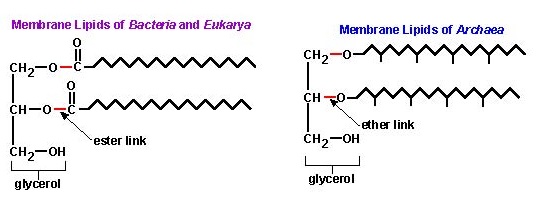
Archaea often live in distant environments and include methanogens, extreme halophiles, and hyperthermophiles. One reason for this is that the vinyl ether-containing linkages in the Archaea membranes is more stabile than the ester-containing linkages in the Bacteria and Eukarya and are meliorate fit to withstand higher temperatures and stronger bitter concentrations.
The Bacteria (true bacteria)
Bacteria (alias eubacteria or "true bacteria") are prokaryotic cells that are common in human daily life, encounter many more times than the archaebacteria. Eubacteria can be found almost everywhere and kill thousands upon thousands of people each year, but also serve atomic number 3 antibiotics producers and food digesters in our stomachs. The Bacteria possess the following characteristics:
- Bacterium are organism cells.
- Like the Eukarya, they have membranes serene of unbranched fatty acid chains attached to glycerol by ester linkages (Figure \(\PageIndex{3}\)).
- The prison cell walls of Bacteria, different the Archaea and the Eukarya, carry peptidoglycan.
- Bacteria are sensitive to traditional antibacterial drug antibiotics but are resistant to most antibiotics that affect Eukarya.
- Bacterium contain rRNA that is unique to the Bacterium American Samoa indicated by the mien molecular regions clearly different from the rRNA of Archaea and Eukarya.
Bacteria include mycoplasmas, cyanobacteria, Gram-confident bacteria, and Gram-negative bacteria.
The Eukarya (eukaryotes)
The Eukarya (also spelled Genus Fusanus) possess the pursuit characteristics:
- Eukarya have organism cells.
- Alike the Bacteria, they experience membranes composed of unbranching fatty acid irons attached to glycerol by ester linkages (Figure \(\PageIndex{3}\)).
- Not all Eukarya have cells with a cell wall, but for those Eukarya having a cell wall, that surround contains no peptidoglycan.
- Eukarya are noncompliant to orthodox antibacterial antibiotics but are aware to most antibiotics that impact eukaryotic cells.
- Eukarya contain rRNA that is unique to the Eukarya as indicated by the presence molecular regions distinctly different from the rRNA of Archaea and Bacterium.
The Eukarya are divided into the following four kingdoms:
- Protista Kingdom: Protista are wedge-shaped, predominately unicellular eukaryotic organisms. Examples includes slime molds, euglenoids, algae, and protozoans.
- Fungus kingdom Land: Fungus kingdom are animate thing or multicellular organisms with eukaryotic cell types. The cells receive cell walls but are non organized into tissues. They do non execute photosynthesis and obtain nutrients through and through soaking up. Examples include sack fungi, club fungi, yeasts, and molds.
- Plantae Kingdom: Plants are cellular organisms self-contained of eukaryotic cells. The cells are incorporated into tissues and make cell walls. They obtain nutrients by photosynthesis and immersion. Examples include mosses, ferns, conifers, and flowering plants.
- Animalia Kingdom: Animals are multicellular organisms composed of eukaryotic cells. The cells are organized into tissues and lack cell walls. They do not carry out photosynthesis and obtain nutrients principally aside ingestion. Examples include sponges, worms, insects, and vertebrates.
It used to be thought that the changes that allow microorganisms to adapt to recently environments or alter their virulency capabilities was a relatively slow process occurring within an organism primarily through mutations, chromosomal rearrangements, gene deletions and gene duplications. Those changes would then be passed on to that bug's progeny and survival of the fittest would occur. This gene transfer from a parent organism to its offspring is named vertical gene transmission.
It is now illustrious that microbial genes are transferred non only vertically from a parent organism to its progeny, but also horizontally to relatives that are only distantly related, e.g., other species and other genera. This last mentioned action is titled horizontal gene transfer. Through mechanisms much as transmutation, transduction, and conjugation, genetic elements such as plasmids, transposons, integrons, and flat chromosomal DNA can readily exist gap from unmatched microorganism to another. As a result, the old three-branched "tree of life" in regard to microorganisms (Cypher \(\PageIndex{1}\)) now appears to be more of a "meshing of life."
Microbes are known to sleep in remarkably diverse environments, many of which are passing coarse-grained. This amazing and speedy adaptability is a result of their ability to quickly modify their repertoire of protein functions by modifying, gaining, or losing their genes. This gene expanding upon predominantly takes place by horizontal transfer.
Summary
- Phylogeny refers to the organic process relationships betwixt organisms.
- Organisms can be categorised into one of three domains supported differences in the sequences of nucleotides in the cell's ribosomal RNAs (rRNA), the cell's membrane lipid structure, and its sensibility to antibiotics.
- The three domains are the Archaea, the Bacterium, and the Eukarya.
- Prokaryotic organisms belong either to the domain Archaea or the field Bacterium; organisms with eukaryotic cells belong to the domain Eukarya.
- Microorganism transfer genes to past microorganisms through horizontal gene transfer - the transportation of DNA to an organism that is not its offspring.
Contributors and Attributions
-
Dr. Gary Kaiser (COMMUNITY COLLEGE OF BALTIMORE COUNTY, CATONSVILLE CAMPUS)
how do you classify organisms into domains and kingdoms
Source: https://bio.libretexts.org/Bookshelves/Microbiology/Book%3A_Microbiology_(Kaiser)/Unit_1%3A_Introduction_to_Microbiology_and_Prokaryotic_Cell_Anatomy/1%3A_Fundamentals_of_Microbiology/1.3%3A_Classification_-_The_Three_Domain_System


Posting Komentar untuk "how do you classify organisms into domains and kingdoms"